Sulfuric
acid, one of the most important, highly corrosives of all industrial
chemicals, can be dangerous.
Pipe lines carrying
sulfuric acid are commonly found in numerous chemical processing
plants as well as other industrial facilities. This acid is one
of the highest volume chemicals produced in the United States.
The hazardous
nature of sulfuric acid is demonstrated by adding a drop of water
to concentrated acid. This mixture creates an intense heat evolution
sufficient to soften most plastic materials.
For piping systems
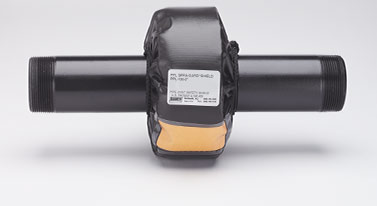
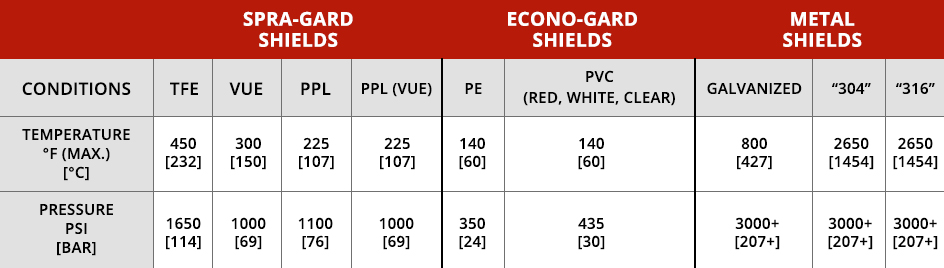
carrying sulfuric acid, the TFE Spra-Gard® Shield is the RAMCO®
Safety Shield that is specified most frequently. It can resist sulfuric
acid at any concentration including the fuming form, oleum. Only
this RAMCO® Shield can be used in this fashion. Others are suitable
within certain limitations. At temperatures higher than 450°F
(232°C), stainless steel is mandatory, although some corrosive
attack and pitting may occur.
For dilute sulfuric
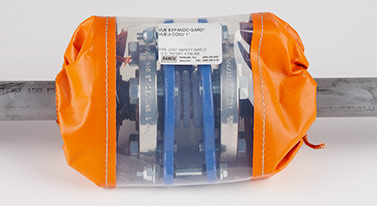
acid, 30% or less, PPL and PPL (VUE) Spra-Gard® Shields can
be used at temperatures up to 200°F (93°C). PE and PVC EconoGard®
Shields are recommended at temperatures up to 140°F (60°C).
At ambient temperatures,
TFE, VUE, PPL and PPL (VUE) Spra-Gard® Shields can be used for
concentrated sulfuric acid, 93% or 98%. In laboratory tests at these
concentrations, PVC and PE Econo-Gard® Shields suffered degradation
and consequently, are not recommended.
Ammonia
Ammonia is among
the chemicals considered by the Occupational Safety and Health Administration
(OSHA), to be a recognized hazard and is listed as such in the agency’s
“General Industry Safety and Health Standards”. Safety
shields frequently are specified to protect against leaks and sprayouts
in ammonia lines.
RAMCO®’s
low cost PE Econo-Gard® Shield is resistant to ammonia at ambient
temperatures and many of its compounds at temperatures up to 140°F
(60°C). PPL and PPL (VUE) Spra-Gard® Shields can be used
on ammonia lines at temperatures up to 225°F (107°C) while,
the TFE Spra-Gard® Shield is suggested up to 450°F (232°C)
temperatures. For higher temperatures, “304” and “316”
stainless steel show excellent resistance to ammonia and most of
its compounds.
Phosphoric
Acid
Although the
acid associated with phosphorus is usually referred to as phosphoric
acid, a group of several different acids are formed from phosphorus:
While these
are considered strong acids, they are weaker than sulfuric acid.
They do not have the powerful oxidizing properties of sulfuric acid
and also are less volatile.
The complete
RAMCO® Safety Shield product-line — except galvanized
steel — is suitable for installation with these acid lines.
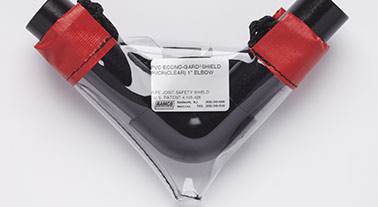
The Econo-Gard® Shields, PVC and PE, are appropriate for concentrations
up to 85% for temperatures up to 140°F (60°C).
TFE Spra-Gard®
Shields are resistant at all concentrations with temperature limitations
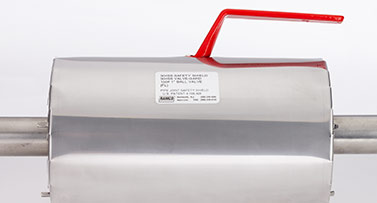
of 450°F (232°C), and the Stainless Steel Safety Shields
can be used at higher temperatures.
Oxides
and Hydroxides
Sodium hydroxide,
also known as caustic soda, is the most important commercial caustic.
Several other oxides — sodium hydroxide, lithium hydride,
calcium oxide, barium (soluble compounds) — are classified
by OSHA, the United States Occupational Safety and Health Administration,
as recognized hazards.
Many of the
RAMCO® Safety Shields are effective in shielding piping connections
of these chemical lines at varying temperatures. Because of the
number of chemicals in these categories, it is advisable to contact
the RAMCO® Technical Services Group for assistance.
Acetone
Acetone, an
important and widely used chemical, is a strong solvent that is
highly flammable. It is popular as a paint and varnish remover and
also is used extensively in the manufacture of various chemicals
and drugs.
For systems
using this chemical, Spra-Gard® Shields and RAMCO® Stainless
Steel Shields are advised. While PPL and PPl (VUE) Shields may be
used up to 121°F (49°C), TFE Shields may be used up to 450°F
(232°C). Above this temperature, “304” or “316”
RAMCO® Shields, seem particularly suitable for such applications.
Hydrofluoric
Acid
Hydrofluoric
acid, hydrogen fluoride in an aqueous solution, is very violent
and extremely hazardous. The element fluorine, a strong oxidizing
agent, reacts violently with water and is toxic.
Although this
acid is not frequently used, in contact with glass it reacts intensely
and consequently, is used to etch glass. Hydrofluoric acid is also
used in petroleum cracking operations.
Because of the
potential harm of this acid, shielding of its piping systems is
strongly advised. RAMCO® PPL and PPL (VUE) Spra-Gard® Shields
are recommended for concentrations up to 60% and temperatures up
to 200°F (93°C). Above this concentration or temperature,
only RAMCO® “316” Stainless Steel Shields are indicated.
Steam
and Lubrication Oil
Other extremely
dangerous conditions, in the event of a leak/sprayout, are piping
systems carrying live steam under pressure or hot oil applications.
To provide effective
shielding, either RAMCO® Galvanized Shields or the Navy Spray
Shields are recommended.
“Liquors”
Three types
of liquors (any aqueous solution of one or more chemical compounds)
are used extensively in the pulp and paper industries. Black liquor,
also called spent sulfate liquor, is liquid digester waste containing
sulfonated lignin, rosin acids and other waste-wood components from
which tall oil is made. Green liquor is a solution made by dissolving
chemicals that are recovered in the alkaline pulping process in
water, and white liquor is made by adding caustic soda to a sodium
sulfide solution.
Because of the
hazardous nature of the chemicals in these liquors, RAMCO® Safety
Shields are commonly installed in pulp and paper manufacturing plants.
The TFE Spra-Gard® and the VUE-Gard® Shields are the shields
of choice because of their wide spectrum of chemical resistance.