Selection
Guide: Product Part Numbers
For product
identification, RAMCO® uses a three part code system. The first
three or four digits identify the material from which the shield
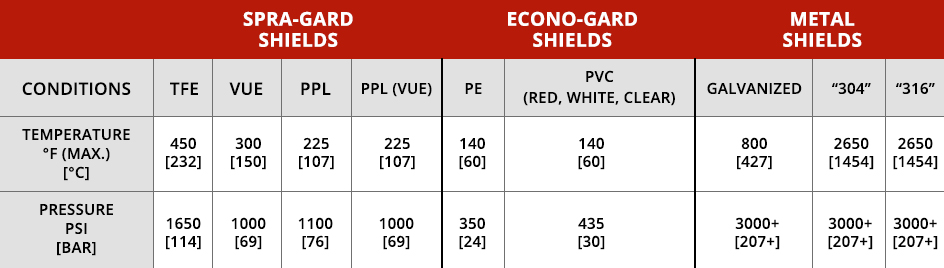
is made — TFE, VUE, PPL, PPL (VUE), PVCR, etc. The second
part denotes the pressure rating of the pipeline, such as 150 psi
and the third, gives the pipe size.
An example
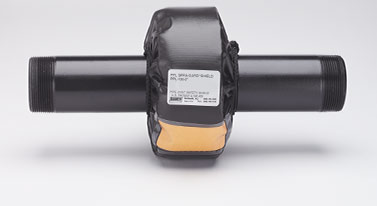
for a flange shield is PPL-150-2:
“PPL”
indicates the material from which the shield is made
“150”
is the pipe pressure rating
“2”
is the pipe size
Frequently used
RAMCO® product identification codes follows:
 |
First
Digit Grouping: |
| |
|
| |
TFE -
tetrafluoroethylene coated fiberglass
VUE - TFE/ECTFE
PPL - polypropylene
PPLV - PPL/ECTFE
PVCR - polyvinyl chloride (red)
PVCW - polyvinyl chloride (white)
PVCC - polyvinyl chloride (clear)
PE - polyethylene
304 - “304” stainless steel
316 - “316” stainless steel
GAL - galvanized steel |
| |
|
 |
Second
Digit Grouping: |
| |
|
| |
150 -
150 psi
300 - 300 psi
600 - 600 psi
900 - 900 psi
1500 - 1500 psi
3000 - 3000 psi
TEE - Tee
CPG - Coupling
ELB - Elbow
UNI - Union |
| |
|
 |
Third
Digit Grouping: |
| |
|
| |
From
1/4” up to 60” Pipe Size |
Metal shields,
galvanized and stainless steel, for special conditions may be fitted
with a mesh Liner (M). An example of the product code for a “304”
flange shield for a 3” pipe with a mesh liner and a pressure
rating of 600 psi is:
304M-600-3
If a mesh liner
is not required, the product code is:
304-600-3
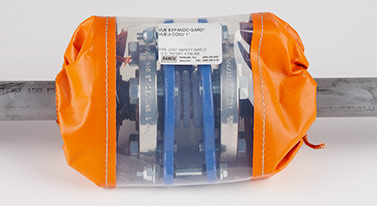
Expando-Gard®
Shields
As with flanges,
the first digit grouping identifies the material of the Expando-Gard®
Shield. The second grouping is EXP. The first set of numbers after
EXP indicates the number of convolutions (1-10) of the joint and
the following group, the pipe size (1/2” – 60+”).
An example for a 20” 8 convolution expansion joint that is
to be shielded in TFE is:
TFE-EXP-8-20
Valve
Bonnet Shields
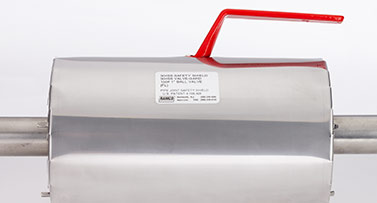
Valve Bonnet
Shields are specially designed for gate and globe valves. And in
some instances, Bonnet Shields are used for large diaphragm valves.
The product
code describes the material from which the shield is made followed
by the two essential measurements of the valve — Height and
Circumference.
An example for
a 2” gate valve with an 8” height and a 16” circumference
that is to be shielded with VUE (TFE/ECTFE) is:
VUE-816
Valve-Gard®
Shields
Because of the
wide variety of valves and valve manufacturers, product codes for
valve shields are quite complex. To keep it simple, we suggest that
the basic information be provided:
pipe
size
type of
valve
its connection
— flanged/threaded/socket weld
pressure
rating
valve manufacturer’s
name
valve model
number
Metal
Drain Gard® Shield
For flange Drain-Gard®
Shields, the product code is similar to that for flange shields.
Since they are fabricated in either “304” or “316”
stainless steel, the first group of digits includes either set of
numbers followed by “D”. This is followed by the pressure
rating of the system and lastly, the pipe size.
The product
code of a RAMCO® Drain-Gard® Shield for a 4” 300 psi
flange in “316” is:
316D-300-4
Metal
Lined Drain Gard® Shields
The product
code for this shield is similar to the Drain-Gard® Shield except
“L” is used to signify the shield lining. An example
of a 2” 600 psi “304” stainless steel lined Drain-Gard®
is:
304LD-600-2
The type of
lining must be stated since it is not part of the product code.
“See-Thru"
Drain Gard® Shields
Not only are
the Vue- and the PPL (Vue)-Drain-Gard® Shields available for
flanges, but they can be fabricated for valves, expansion joints
and other fittings. The product codes for either thermoplastic material
for a 3” 150 psi flange are:
VDG-150-3
PPVD-150-3
Product codes
for other joint connections warrant discussion with local distributors
or Ramco® personnel.
Lest
you forget ...
To select the
appropriate RAMCO® Safety Shields for any pipe connection, it
is necessary to know:
chemical
flowing though the valve
temperature
of the chemical
pressure
rating of the system
For special
or custom shield fabrication technical assistance is available from
the RAMCO® Technical Services Group.
|